Analysis of U.S. Food and Drug Administration (FDA) monthly refusal data shows that 73% of shrimp shipments refused for banned antibiotics in 2026 have originated from processors operating with certifications under the Best Aquaculture Practices (BAP) program.
Executive Summary
The U.S. Food and Drug Administration (FDA) reported 102 seafood entry line* refusals in September 2026.
2026 SHRIMP ANTIBIOTIC REFUSALS BY THE NUMBERS (January to September)
Total FDA Seafood Refusals (September)
102 entry lines
Shrimp Antibiotic Refusals (September)
11 entry lines
Total FDA Seafood Refusals (YTD)
868 entry lines
Shrimp Antibiotic Refusals (YTD)
67 entry lines
Refusals from BAP-Certified Facilities (YTD) 73% (49 entry lines)
Key Takeaways
- In September 2026, 10.8% of all FDA seafood import entry line refusals involved shrimp contaminated with banned antibiotics.
- The FDA refused eleven shrimp entry lines in September 2026 for reasons related to the presence of banned veterinary drug residues.
- Six (54.5%) of the eleven shrimp entry lines refused in September for banned antibiotics originated from a BAP-certified facility.
- A total of 67 shrimp entry lines have been refused for antibiotic residues year-to-date in 2026.
- In 2026, 73% of FDA shrimp entry line refusals related to banned antibiotics originated from BAP-certified facilities.
- The FDA’s Import Refusal Report for September only appears to cover refusals made through September 24th.
Trend Analysis
FDA data in September indicated refusals for shrimp contaminated with veterinary drug residues from five different Asian countries.
- Through the first three quarters of 2026, the countries responsible for the most entry line refusals of shrimp for the presence of veterinary drug residues are India (16), Indonesia (14), and Vietnam (11), followed by China (8), Bangladesh (6), Malaysia (5), and Thailand (3).
- Although FDA sampling continues to confirm the abuse of banned antibiotics in India, Indonesia, and Vietnam, refusals of shrimp from China and Malaysia are the result of repeated efforts by the same exporters to ship to the United States in circumvention of existing Import Alerts.
September 2026 Refusals: Detailed Exporter Data
The FDA refused eleven entry lines of shrimp in September 2026 for reasons related to veterinary drug residues (antibiotics/fungicides).
1. PT. Winaros Kawula Bahari
- Origin: Indonesia
- Refusal Date(s): September 23, 2026
- FDA Division: Southeast Imports
- Violation(s): 4 entry lines refused for Nitrofurans and Veterinary Drug Residues
- Certification Status: 🔴 BAP-Certified (4-Star)
- Processing Plant: P10306
- Farms: F11511
- Import Alert Status: Not currently listed on Import Alert 16-124 (“Detention Without Physical Examination of Aquaculture Seafood Products Due to Unapproved Drugs”), Import Alert 16-127 (“Detention Without Physical Examination of All Seafood Due to Chloramphenicol”), or Import Alert 16-129 (“Detention Without Physical Examination of Seafood Products Due to Nitrofurans”).
2. Bien Dong Hau Giang Seafood Joint Stock Company
- Origin: Vietnam
- Refusal Date(s): September 14, 2026
- FDA Division: West Coast Imports
- Violation(s): 1 entry line of breaded shrimp refused for Nitrofurans, Veterinary Drug Residues, and Nutrition Label
- Certification Status: 🔴 BAP-Certified (4-Star)
- Processing Plant: P10654
- Import Alert Status: Not currently listed on Import Alert 16-124 (“Detention Without Physical Examination of Aquaculture Seafood Products Due to Unapproved Drugs”), Import Alert 16-127 (“Detention Without Physical Examination of All Seafood Due to Chloramphenicol”), or Import Alert 16-129 (“Detention Without Physical Examination of Seafood Products Due to Nitrofurans”).
3. Asian Sea Corporation Public Company Limited
- Origin: Thailand
- Refusal Date(s): September 9, 2026
- FDA Division: West Coast Imports
- Violation(s): 1 entry line refused for Veterinary Drug Residues
- Certification Status: 🔴 BAP-Certified (4-Star)
- Processing Plant: P100028
- Import Alert Status: Listed on Import Alert 16-124 (“Detention Without Physical Examination of Aquaculture Seafood Products Due to Unapproved Drugs”) for gentian violet in “coconut shrimp” on May 5, 2026 and for enrofloxacin in “breaded coconut shrimp” on July 9, 2026.
4. Rudong Zhenxiong Trade Co., Ltd.
- Origin: China
- Refusal Date(s): September 16, 2026
- FDA Division: West Coast Imports
- Violation(s): 1 entry line refused for Unsafe Additive and Veterinary Drug Residues
- Import Alert Status: Not on the “green” list for IA 16-131 (“Detention Without Physical Examination of Aquacultured Shrimp, Dace, and Eel from China and Hong Kong SAR – Presence of New Animal Drugs and/or Unsafe Food Additives”).
5. Golden Fresh Sdn Bhd
- Origin: Malaysia (Palau Pinang)
- Refusal Date(s): September 9, 2026
- FDA Division: West Coast Imports
- Violation(s): 4 entry lines of breaded shrimp refused for Unsafe Additive (while no code specifically related to veterinary drug residues was reported, the FDA has recently been using “Unsafe Additive” in combination with “Veterinary Drug Residues” for exporters from China on Import Alert 16-131 and appears to now be using “Unsafe Additive” exclusively for refusals of shrimp shipments from exporters in peninsular Malaysia subject to Import Alert 16-136).
- Import Alert Status: Not on the “green” list for IA 16-136 (“Detention without Physical Examination of Aquacultured Shrimp and Prawn Products in all Market Forms from Peninsular Malaysia Due to the Presence of Unapproved Animal Drugs or Unsafe Food Additives”).
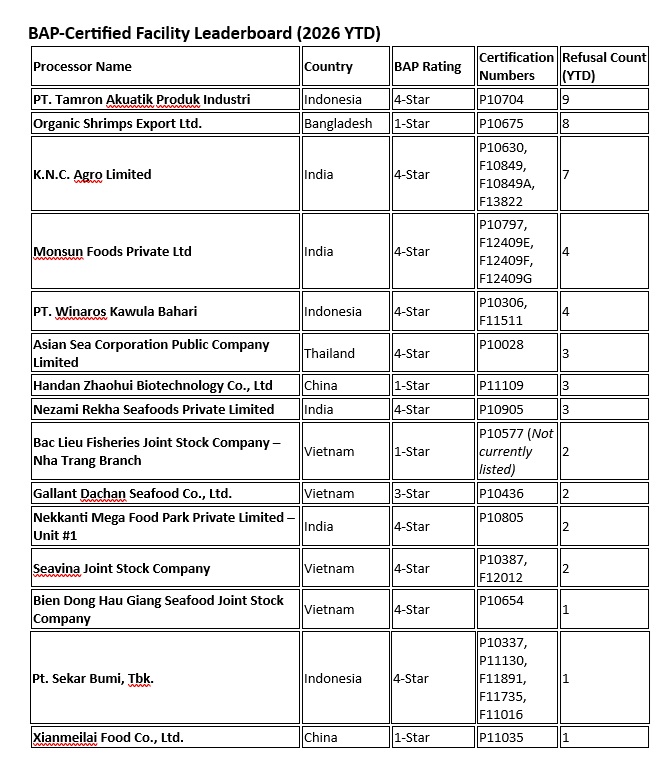
BAP-Certified Facility Tracker (2026 YTD)
The Best Aquaculture Practices (BAP) certification program, operated by the Global Seafood Alliance, is widely used by retailers and seafood brands to indicate that seafood is safe and responsibly farmed.
73% of shrimp entry lines refused for antibiotics in the first three quarters of 2026 originated from facilities that operated with BAP certifications this year. This finding raises questions about whether third-party certification audits adequately detect banned veterinary drug use at farms and processing plants.
The shrimp entry lines refused by the FDA for banned antibiotics in 2026 originated from eleven BAP-certified facilities operating in six different countries (Bangladesh, China, India, Indonesia, Thailand, and Vietnam), led by Indonesia’s PT. Tamron Akuatik Produk Industri, followed by Bangladesh’s Organic Shrimps Export Ltd.
Historical Context & Data Trends
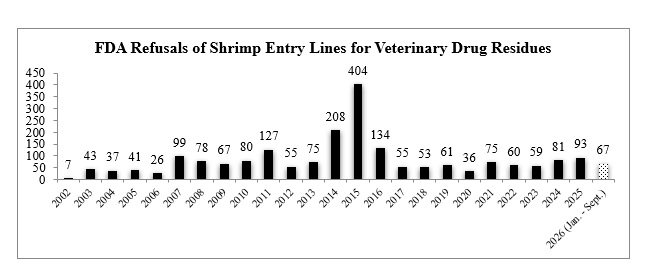
FDA Refusals of Shrimp Entry Lines for Veterinary Drug Residues
2026 YTD Total: 67
2025 Full Year: 93 (the 6th highest total in 24 years)
Regulatory & Public Health Notes
Another BAP-Certified Vietnamese Shrimp Processor Added to Import Alert 16-129 (“Detention Without Physical Examination of Seafood Products Due to Nitrofurans”) in September
In addition to the refusals for veterinary drug residues announced by the FDA, the federal agency also added Gallant Ocean (Viet Nam) JSC to Import Alert 16-129 for nitrofurans in its shipments of shrimp on September 15, 2026. Gallan Ocean (Viet Nam) JSC holds a 3-Star BAP-certification for its processing plant (P10443).
The Global Seafood Alliance Still Has Not Publicly Issued Its Response to the Senate HELP Committee
In May of 2026, the Senate Health, Education, Labor, and Pensions (HELP) Committee issued letters requesting information regarding the operations of certification programs maintained by the Marine Stewardship Council, the Aquaculture Stewardship Council, and the Global Seafood Alliance. Notably, although the Marine Stewardship Council and the Aquaculture Stewardship Council have publicly released their responses to these letters, the Global Seafood Alliance has not publicly issued its response to the Senate HELP Committee’s questions.
*What is an entry line? An entry line refers to each unique product form included in a container. A single shipment generally will include multiple entry lines. For example, if a container contains retail bags of 16/20 count headless, shell-on shrimp and 21/25 count headless, shell-on shrimp, then there will be two entry lines associated with that single shipment. Entry lines do not provide volume data.
Report Source: FDA’s Operational and Administrative System for Import Support (OASIS) data analyzed by the Southern Shrimp Alliance.