Analysis of U.S. Food and Drug Administration (FDA) monthly refusal data shows that 79% of shrimp shipments refused for banned antibiotics in 2026 have originated from processors operating with certifications under the Best Aquaculture Practices (BAP) program.
Through an Import Alert updated in August, the FDA provided a substantially more detailed accounting of the risks of antibiotics commonly found in shrimp aquaculture.
Executive Summary
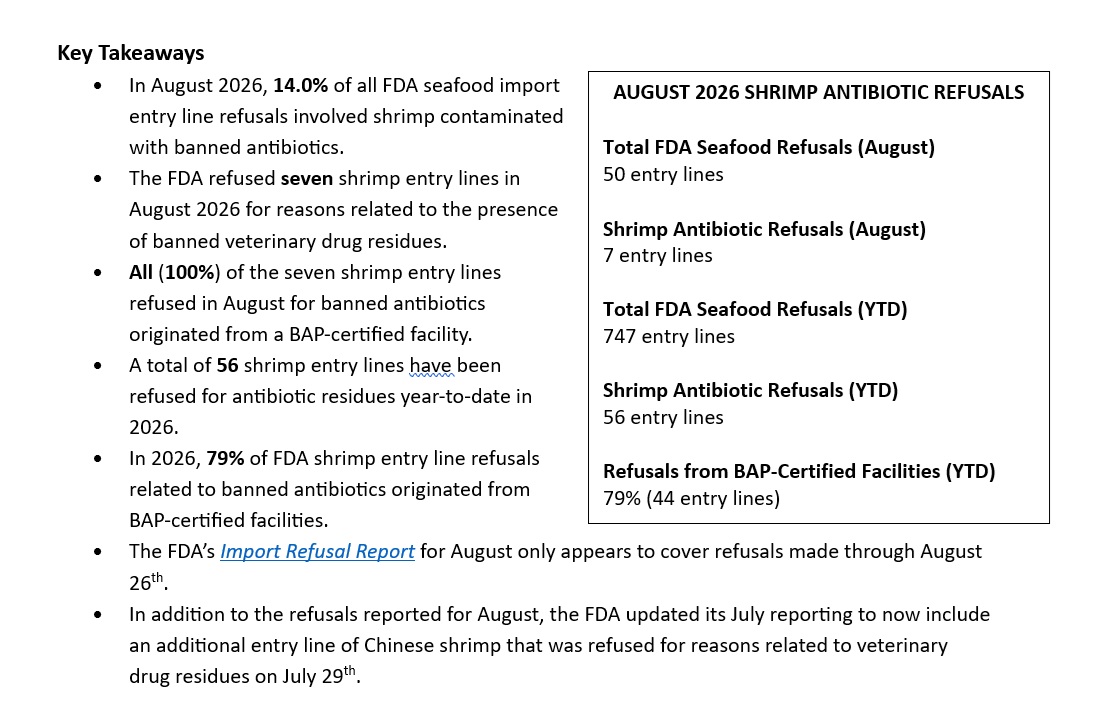
The U.S. Food and Drug Administration (FDA) reported 50 seafood entry line* refusals in August 2026.
Trend Analysis
FDA refusal data in August found shrimp contaminated with veterinary drug residues from two different countries.
- Through the first eight months of 2026, the countries responsible for the most entry line refusals of shrimp for the presence of veterinary drug residues are India (16), Indonesia (10), and Vietnam (10), followed by China (7) and Bangladesh (6).
- India, Indonesia, and Vietnam accounted for 51% of the volume of frozen shrimp imported into the United States over the first half of 2026.
August 2026 Refusals: Detailed Exporter Data
The FDA refused seven entry lines of shrimp in August 2026 and reported refusing one additional entry line in July 2026 for reasons related to veterinary drug residues (antibiotics/fungicides).
1. K.N.C. Agro Limited
- Origin: India
- Refusal Date(s): August 17, 2026
- FDA Division: Southeast Imports
- Violation(s): 6 entry lines refused for Nitrofurans
- Certification Status: 🔴 BAP-Certified (4-Star)
- Processing Plant: P10630
- Farms: F10849, F10849A, F13822
- Import Alert Status: Listed on Import Alert 16-129 (“Detention Without Physical Examination of Seafood Products Due to Nitrofurans”) on June 9, 2026.
2. Xianmeilai Food Co., Ltd.
- Origin: China
- Refusal Date(s): August 24, 2026
- FDA Division: West Coast Imports
- Violation(s): 1 entry line of breaded shrimp refused for Unsafe Additive and Veterinary Drug Residues
- Certification Status: 🔴 BAP-Certified (1-Star)
- Processing Plants: P11035
- Import Alert Status: Not on the “green” list for IA 16-131 (“Detention Without Physical Examination of Aquacultured Shrimp, Dace, and Eel from China and Hong Kong SAR – Presence of New Animal Drugs and/or Unsafe Food Additives”).
3. Hoptai Marine Products Company Limited
- Origin: Hong Kong
- Refusal Date(s): July 29, 2026
- FDA Division: Northeast Imports
- Violation(s): 1 entry line refused for Unsafe Additive and Veterinary Drug Residues
- Import Alert Status: Not on the “green” list for IA 16-131 (“Detention Without Physical Examination of Aquacultured Shrimp, Dace, and Eel from China and Hong Kong SAR – Presence of New Animal Drugs and/or Unsafe Food Additives”).
BAP-Certified Facility Tracker (2026 YTD)
The Best Aquaculture Practices (BAP) certification program, operated by the Global Seafood Alliance, is widely used by retailers and seafood brands to indicate that seafood is safe and responsibly farmed.
79% of shrimp entry lines refused for antibiotics in the first eight months of 2026 originated from facilities that operated with BAP certifications this year. This finding raises questions about whether third-party certification audits adequately detect banned veterinary drug use at farms and processing plants.
In May, the Senate Health, Education, Labor, and Pensions (HELP) Committee issued letters requesting information regarding the operations of certification programs maintained by the Marine Stewardship Council, the Aquaculture Stewardship Council, and the Global Seafood Alliance. Notably, although the Marine Stewardship Council and the Aquaculture Stewardship Council have publicly released their responses to these letters, the Global Seafood Alliance has not made its response available.
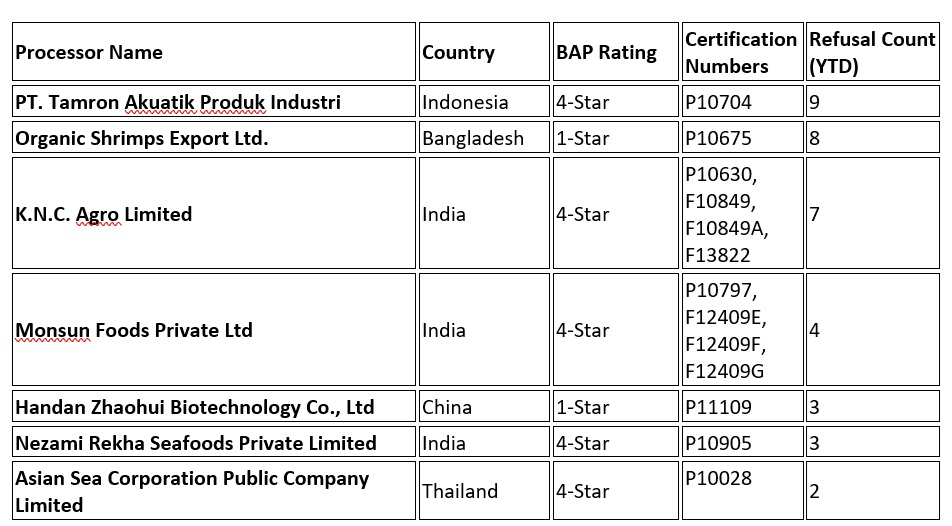
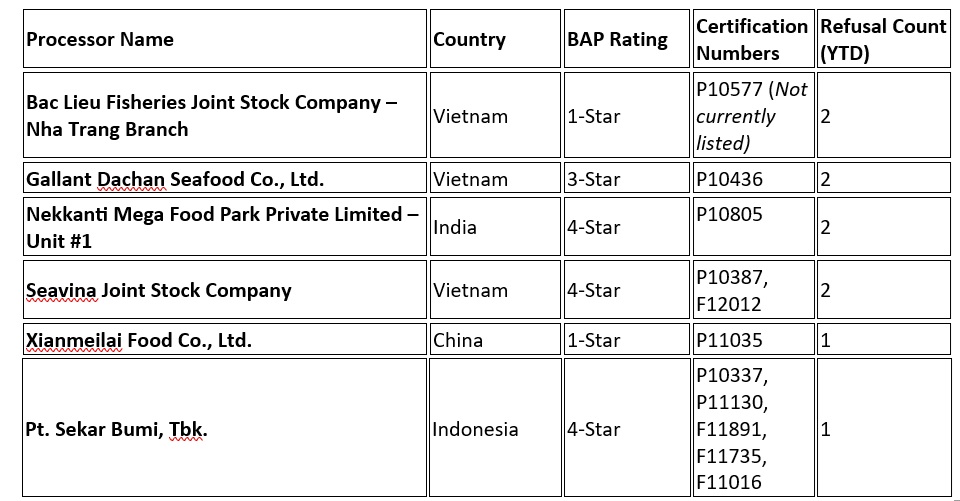
The shrimp entry lines refused by the FDA for banned antibiotics in 2026 originated from ten BAP-certified facilities operating in six different countries (Bangladesh, China, India, Indonesia, Thailand, and Vietnam), led by Indonesia’s PT. Tamron Akuatik Produk Industri, followed by Bangladesh’s Organic Shrimps Export Ltd.
BAP-Certified Facility Leaderboard (2026 YTD)
Historical Context & Data Trends
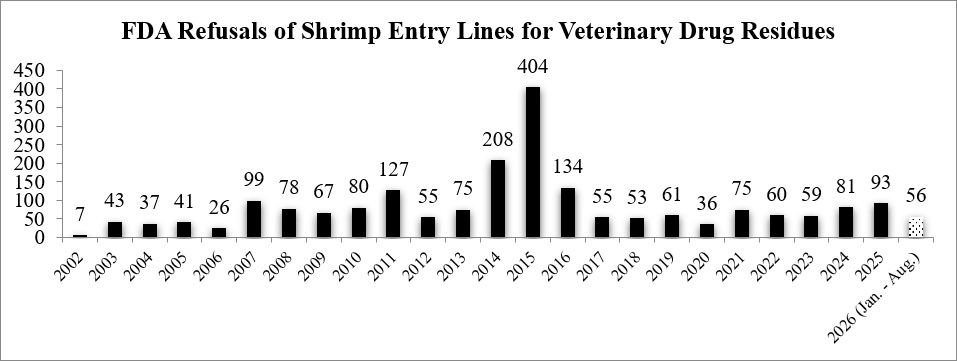
FDA Refusals of Shrimp Entry Lines for Veterinary Drug Residues
2026 YTD Total: 56
2025 Full Year: 93 (the 6th highest total in 24 years)
Regulatory & Public Health Notes
Other Shrimp Entry Line Refusals
In addition to the refusals for veterinary drug residues announced by the FDA, the federal agency also reported refusing an entry line of shrimp from the Indian exporter Ananda Enterprises (India) Private Limited for “added bulk” on August 16, 2026. The FDA added Ananda Enterprises to Import Alert 99-47, “Detention Without Physical Examination of Human Food Products That Appear to be Adulterated for Economic Gain,” on July 16, 2026 for its shipments of shrimp “because it appears to have a substance added to, mixed or packed with it so as to increase its bulk or weight, or reduce its quality or strength, or make it appear better or of greater value than it is.” Ananda Enterprises holds numerous BAP-certifications for hatcheries, farms, feed mills, and its processing plant (P10372; 4-Star).
FDA Highlights Significant Risks from Antibiotics in Aquaculture in Update to Import Alert on Malaysian Shrimp
In August, the FDA also updated Import Alert 16-139, “Detention without Physical Examination of Aquacultured Shrimp and Prawn Products in all Market Forms from Peninsular Malaysia Due to the Health Risks of Antibiotic Use in Shrimp Aquaculture,” to clarify that the Import Alert applied to all shrimp originating from or shipped out of every state and federal territory in Malaysia except Sabah, Sarawak, and Labuan.
The FDA also updated its explanation for the basis of Import Alert 16-139, noting that the use of antibiotics in shrimp aquaculture constituted a food additive presenting significant health risks to American consumers (emphasis added):
“The extensive commercialization and high consumption of aquacultured seafood products continue to rise worldwide. Aquacultured seafood has become the fastest-growing sector of the world’s food economy, accounting for more than half of all global seafood production. Approximately 90% of the seafood consumed in the U.S. is imported from foreign countries, and over 40% of that imported seafood originates from aquaculture operations. Malaysia remains one of the key suppliers of shrimp and prawns to the U.S. market (NOAA National Marine Fisheries Service.
Aquaculture, also known as fish and shellfish farming, refers to the breeding, rearing and harvesting of aquatic food animals under environmentally controlled conditions with some form of intervention designed to enhance production, such as regular stocking, feeding, prevention and treatment of diseases, protection from predators, etc.
As the aquaculture industry continues to expand, concerns regarding the use of unapproved animal drugs and unsafe chemicals, and the misuse of approved animal drugs during aquaculture production has increased significantly. The existing scientific evidence demonstrates that the administration of pharmacologically active compounds during the various aquaculture life-cycle stages can result in the presence of residues in the edible portion of the finished seafood products. The consumption of these products may have an adverse impact on human health. A public health concern exists regarding prolonged exposure to nitrofurans and chloramphenicol, broad-spectrum antimicrobial drugs used in food-producing animals. Residues of these drugs in food products may present a potential health risk to consumers. These compounds are known to have carcinogenic and genotoxic properties. Also, the introduction of these residues into the food supply can contribute to the development and spreading of antimicrobial-resistant (AMR) bacterial strains. These resistant pathogens may be transferred to and cause infections in humans, compromising the effectiveness of critical antimicrobial treatments vital to human medicine. (see 21 C.F.R. 510.110(c)). Based on a robust body of scientific evidence, the FDA has determined that the detection of parent compounds or metabolite marker residues of nitrofurans and chloramphenicol in shrimp is directly linked to the administration of these prohibited veterinary drugs during the aquaculture production stages (i.e., hatcheries, farms).
Nitrofurans and chloramphenicol are classified as drugs under Section 201(g)(1) of the FD&C Act when intended to diagnose, cure, mitigate, treat, or prevent disease, or to affect the structure or function of aquacultured shrimp or prawns. Because they are not generally recognized as safe and effective for these purposes, they are considered “new animal drugs” under Section 201(v)(1). Pursuant to Section 512(a)(1), the use or intended use of a new animal drug requires an approved new animal drug application, conditional approval, or index listing. The FDA has not approved any of these applications for the use of nitrofurans or chloramphenicol in shrimp or prawns. Therefore, these substances are considered to be unsafe new animal drugs within the meaning of section 512(a)(1). Consequently, the presence of these parent drugs or their metabolite conversion products in processed shrimp or prawns renders the food adulterated under Section 402(a)(2)(C)(ii) of the FD&C Act.
The FDA has determined that using nitrofurans or chloramphenicol at any life stage of an animal results in residues in the final edible products. Because these substances are not generally recognized as safe for human consumption, any residues not classified as “new animal drugs” are deemed food additives under Section 201(s) of the FD&C Act.
Under Section 409, food additives are considered unsafe unless the FDA has issued a specific regulation or exemption authorizing their safe use. No such regulations or exemptions exist for nitrofurans or chloramphenicol in food-producing animals. Because these residues present clear human food safety risks, they are classified as unsafe food additives. Consequently, the presence of nitrofuran or chloramphenicol residues in food, including shrimp and prawns, renders the product adulterated under Section 402(a)(2)(C)(i) of the FD&C Act and subjects it to regulatory action.”
With these additions, the FDA has now provided a substantially more detailed accounting of the risks presented by chloramphenicol and nitrofurans than is currently presented in the Import Alerts on seafood specific to those antibiotics (Import Alert 16-127 and Import Alert 16-129, respectively).
*What is an entry line? An entry line refers to each unique product form included in a container. A single shipment generally will include multiple entry lines. For example, if a container contains retail bags of 16/20 count headless, shell-on shrimp and 21/25 count headless, shell-on shrimp, then there will be two entry lines associated with that single shipment. Entry lines do not provide volume data.
Report Source: FDA’s Operational and Administrative System for Import Support (OASIS) data analyzed by the Southern Shrimp Alliance.