Consumers Deserve Transparency
The Southern Shrimp Alliance (SSA) is working to address deceptive marketing of farm-raised imported shrimp as U.S. wild-caught shrimp, a common practice that deprives consumers of choice and economically cripples multigenerational U.S. shrimping families.

Consumers aren’t getting the premium U.S. wild-caught shrimp they expect based on marketing, menu descriptions, and restaurant staff. To raise awareness and promote change, SSA sponsors genetic testing of shrimp dishes at restaurants.
The testing results below provide a market-by-market snapshot of shrimp authenticity and the laws being used to improve seafood labeling and consumer disclosure.
Shrimp Misrepresentation at a Glance
Genetic testing of shrimp dishes shows how often restaurants serve imported farmed shrimp under the guise of premium U.S. wild-caught.
Why Seafood Labeling Laws Are Needed
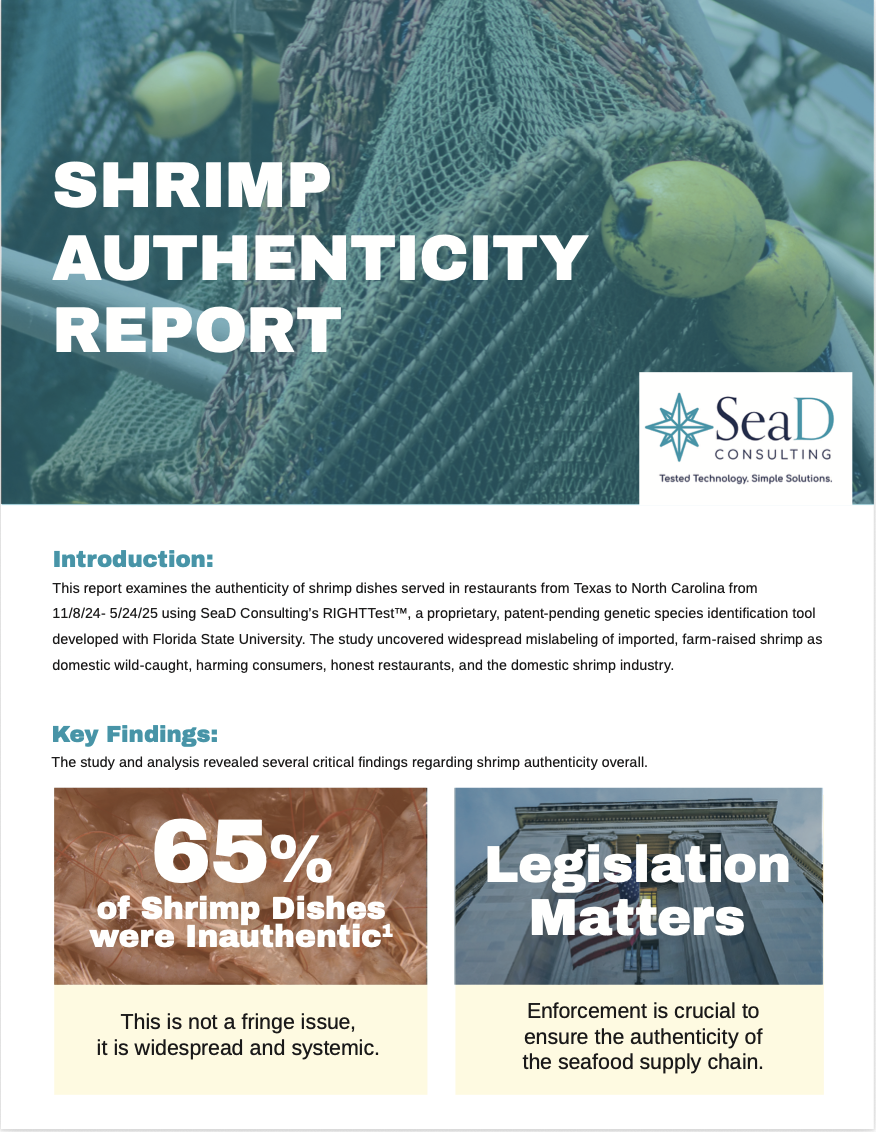
The 2025 report provides the broader context behind the testing results on this page, examining the importance of transparent labeling in the U.S. shrimp industry and the role of labeling laws, testing, and enforcement.
- Misrepresentation is widespread: imported farm-raised shrimp are often presented as U.S. wild-caught.
- Labeling laws matter: the study found higher authenticity rates in states with active labeling laws.
- Laws need enforcement: the report says routine testing is essential to ensure compliance and deter deceptive practices.
- Enabling consumer choice: mislabeling affects consumers, honest restaurants, and the domestic shrimp industry.
State Seafood Labeling Laws & Testing Results
Select a shrimp-producing state below to review its seafood labeling requirements and all restaurant testing currently reported by SeaD Consulting.

Alabama
Law in effect
▼
Alabama
Statutory Provisions & Scope
Alabama's seafood labeling law requires food establishments, from grocery stores to restaurants, to disclose whether seafood is imported or domestic and whether it is farm-raised or wild-caught.
2026 update (HB 444): Seeks to strengthen enforcement by giving the Agriculture and Industries Commissioner authority to test for compliance and revising consumer notification and violation reporting.
Independent Market Testing
Festival & Event Testing

Florida
No labeling law
▼
Florida
Statutory Provisions & Status
Florida has state law regarding labeling for produce and honey produce and honey, but nothing specific to shrimp.
Two bills introduced in 2025 would have created a wild-seafood certification program and required disclosure of imported seafood; both were reported to have died in committee in June 2025.
Independent Market Testing

Georgia
Law in effect
▼
Georgia
Statutory Provisions & Rules
In May 2026, Georgia enacted HB 117 requiring restaurants serving foreign imported shrimp to conspicuously disclose "FOREIGN IMPORTED" on each applicable menu item or display "FOREIGN IMPORTED SHRIMP" on a visible placard. State-operated food service establishments are exempt.
Independent Market Testing

Louisiana
Law in effect
▼
Louisiana
Statutory Framework
Louisiana has required restaurants to disclose shrimp origin longer than any state (2008 law). Amendments effective January 1, 2025 require establishments to state whether seafood is from the U.S. or another country. Proprietors serving foreign seafood must include an additional disclaimer that states: “Some items served at this establishment may contain imported seafood. Ask for more information.”
Prohibits misleading Louisiana-related images, phrases, colors or styles for foreign seafood products.
Independent Market Testing
Festival & Event Testing

Mississippi
Law in effect
▼
Mississippi
Statutory Provisions
Beginning July 1, 2025, seafood and crawfish sold in Mississippi must be clearly labeled imported or domestic. Strengthened July 2026 to prohibit misrepresentation of imported seafood as domestic and require country-of-origin disclosure.
Independent Market Testing

North Carolina
No labeling law
▼
North Carolina
Statutory Status
No seafood labeling law or pending legislation specific to shrimp has been identified.
Independent Market Testing

South Carolina
Law enacted
▼
South Carolina
Statutory Provisions (H4248)
In June 2026, South Carolina passed H4248 requiring food service establishments to display a disclaimer on menus and a sign visible at the main entrance indicating the use of foreign, imported shrimp.
Independent Market Testing

Texas
Law in effect
▼
Texas
Statutory Restrictions
Texas legislation passed in May 2025 requires suppliers, wholesalers and distributors to disclose if shrimp is imported. Restaurants may not label or represent imported shrimp as "Texas shrimp," "Gulf shrimp," "American shrimp," or "Domestic shrimp."
Independent Market Testing
Find Sampled Restaurants Serving U.S. Wild-Caught Shrimp
Explore restaurants identified through Southern Shrimp Alliance testing as serving authentic U.S. wild-caught shrimp.
Federal Seafood Labeling Requirements
Unlike in grocery stores, there is no federal legal requirement that restaurants disclose country-of-origin information regarding the seafood they serve to customers.
Congress empowered the FTC to combat “unfair and deceptive” practices in the marketplace. The FTC guidance makes it clear that a restaurant can be held accountable for creating a false “net impression” about the origin of its seafood, whether a claim is explicit or implied.
… by using photos of fishermen and fishing boats, and saying things like “Eat local,” and “We catch ‘em,” the decorations, menus, and social media may give people what the FTC calls a net (seriously) impression that the restaurant serves fresh, local fish and shrimp. If that isn’t true, the restaurant needs to reel it in. Not only is it illegal to mislead customers about where the seafood is from, it’s also not fair to other restaurants that tell the truth and play by the rules.
SSA continues to work with the FTC to encourage enforcement actions and investigations.
Restaurant Testing Results
All restaurant-market testing results currently reported by the Southern Shrimp Alliance. Retests are shown separately so changes over time remain visible.
| State | Market | Test Date | Sample | Result | Reported Finding | SeaD Consulting Release |
|---|---|---|---|---|---|---|
| AL | Gulf Shores | Apr. 2025 | 44 | 43% (19/44) | Gave impression of U.S. wild-caught shrimp while serving imported farm-raised shrimp. | Press release ↗ |
| AL | Gulf Shores | Oct. 2025 retest | 22 | 45% (10/22) | Previously sampled market continued to give impression of U.S. wild-caught shrimp while serving imports. | Press release ↗ |
| AL | Mobile | Aug. 2025 | 44 | 23% (10/44) | Gave impression of U.S. wild-caught shrimp while serving imported farm-raised shrimp. | Press release ↗ |
| FL | Ft. Lauderdale | Sept. 2025 | 44 | 89% (39/44) | Served imported farm-raised shrimp; 26 explicitly marketed imports as local/domestic. | Press release ↗ |
| FL | Jacksonville | Mar. 2026 | 44 | 68% (30/44) | Served imported farm-raised shrimp; 25 explicitly marketed imports as local/domestic. | Press release ↗ |
| FL | Tampa / St. Petersburg | Jan. 2025 | 44 | 96% (42/44) | Gave impression of U.S. wild-caught shrimp while serving imports. | Press release ↗ |
| FL | Tampa / St. Petersburg | Sept. 2025 retest | 22 | 86% (19/22) | Previously sampled restaurants continued to give impression of U.S. wild-caught shrimp while serving imported farm-raised shrimp. | Press release ↗ |
| GA | Golden Isles | Dec. 2025 | 44 | 100% transparency | 43 dishes used U.S. wild-caught shrimp; one correctly identified farm-raised imports. | Press release ↗ |
| GA | Savannah | Mar. 2025 | 44 | 77% (34/44) | Gave impression of U.S. wild-caught shrimp while serving imports. | Press release ↗ |
| GA | Savannah | May 2026 retest | 22 | 59% (13/22) | Previously sampled restaurants continued to give impression of U.S. wild-caught shrimp while serving imported farm-raised shrimp. | Press release ↗ |
| LA | U.S. 190 Corridor | Mar. 2026 | 24 | 38% (9/24) | Explicitly described U.S. wild-caught shrimp while serving imports. | Press release ↗ |
| LA | Alexandria | June 2025 | 24 | 54% (13/24) | Gave impression of U.S. wild-caught shrimp while serving imported farm-raised shrimp. | Press release ↗ |
| LA | Baton Rouge | Jan. 2025 | 24 | 29% (7/24) | Gave impression of U.S. wild-caught shrimp while serving imports. | Press release ↗ |
| LA | Baton Rouge | Apr. 2026 | 44 | 32% (14/44) | 5/44 correctly disclosed imported shrimp; 9/44 were explicitly inauthentic. | Press release ↗ |
| LA | Baton Rouge | Aug. 2026 | 22 | 27% (6/22) | 100% of imported/farm-raised shrimp were not identified correctly; 50% were explicitly misrepresented as U.S. wild-caught. | Press release ↗ |
| LA | Covington | Feb. 2026 | 24 | 8% (2/24) | Explicitly stated U.S. wild-caught shrimp while serving imports. | Press release ↗ |
| LA | Houma | July 2025 | 24 | 13% (3/24) | Explicitly stated U.S. wild-caught shrimp while serving imports. | Press release ↗ |
| LA | Lafayette | Feb. 2025 | 24 | 33% (8/24) | Gave impression of U.S. wild-caught shrimp while serving imports. | Press release ↗ |
| LA | Lake Charles | May 2025 | 24 | 21% (5/24) | Explicitly stated U.S. wild-caught shrimp while serving imports. | Press release ↗ |
| LA | Monroe | Sept. 2025 | 24 | 54% (13/24) | Explicitly stated U.S. wild-caught shrimp while serving imports. | Press release ↗ |
| LA | Metairie | Jan. 2026 | 24 | 17% (4/24) | Explicitly stated U.S. wild-caught shrimp while serving imports. | Press release ↗ |
| LA | New Orleans — Eastbank | Jan. 2025 | 24 | 13% (3/24) | Explicitly stated U.S. wild-caught shrimp while serving imports. | Press release ↗ |
| LA | New Orleans — Westbank | Dec. 2025 | 24 | 33% (8/24) | Explicitly stated U.S. wild-caught shrimp while serving imports. | Press release ↗ |
| LA | New Orleans | Jan. 2025 | 44 | 25% (11/44) | 11 served imported shrimp; 9 of those 11 (82%) explicitly claimed U.S. wild-caught shrimp. | Press release ↗ |
| LA | Shreveport | Mar. 2025 | 24 | 58% (14/24) | Explicitly stated U.S. wild-caught shrimp while serving imports. | Press release ↗ |
| LA | Slidell | Aug. 2025 | 24 | 13% (3/24) | Explicitly stated U.S. wild-caught shrimp while serving imports. | Press release ↗ |
| MS | Biloxi | Dec. 2024 | 44 | 81% (36/44) | Gave impression of U.S. wild-caught shrimp while serving imports. Test predates current law. | Press release ↗ |
| MS | Biloxi | Apr. 2026 retest | 22 | 23% (5/22) | Indicated shrimp were local or wild-caught through menu labeling or staff assurances. | Press release ↗ |
| MS | Jackson Area | June 2025 | 44 | 64% (28/44) | Gave impression of U.S. wild-caught shrimp while serving imports. Test predates July 2025 law. | Press release ↗ |
| NC | Outer Banks | Dec. 2025 | 44 | 64% (28/44) | Gave impression of U.S. wild-caught shrimp while serving imports. | Press release ↗ |
| NC | Outer Banks | June 2026 retest | 22 | 50% (11/22) | 10 of 11 described shrimp as U.S. wild-caught when it was not. | Press release ↗ |
| NC | Wilmington Area | Apr. 2025 | 44 | 77% (34/44) | Gave impression of U.S. wild-caught shrimp while serving imports. | Press release ↗ |
| SC | Charleston Area | June 2025 | 44 | 90% (40/44) | Gave impression of U.S. wild-caught shrimp while serving imports. | Press release ↗ |
| SC | Charleston Area | Feb. 2026 retest | 22 | 77% (17/22) | Previously sampled restaurants gave impression of U.S. wild-caught shrimp while serving imports. | Press release ↗ |
| SC | Myrtle Beach Area | Feb. 2026 | 44 | 75% (33/44) | Gave impression of U.S. wild-caught shrimp while serving imports. | Press release ↗ |
| TX | Corpus Christi | July 2025 | 44 | 57% (25/44) | Gave impression of U.S. wild-caught shrimp while serving imports. | Press release ↗ |
| TX | Galveston / Kemah | Dec. 2024 | 44 | 59% (26/44) | Gave impression of U.S. wild-caught shrimp while serving imports. | Press release ↗ |
| TX | Galveston / Kemah | Dec. 2025 retest | 22 | 23% (5/22) | Previously sampled restaurants gave impression of U.S. wild-caught shrimp while serving imports. | Press release ↗ |
About the Testing Results
The restaurant testing summarized on this page is conducted by SeaD Consulting through genetic testing of shrimp samples collected from a random selection of restaurants. Results identify whether sampled shrimp are genetically consistent with popular species of farm-raised shrimp and, where reported, document how the shrimp was represented to customers. The statewide comparison at the top of this page excludes retested markets.