On September 4, the U.S. Court of International Trade upheld the U.S. International Trade Commission’s (ITC) findings that subsidized shrimp imports from Ecuador, India, and Vietnam materially injured the U.S. shrimp industry, rejecting three separate exporter appeals.
The federal court’s decisions – Slip Op. 26-105 (Ecuador), 26-106 (India), and 26-107 (Vietnam) – uphold the underlying countervailing duty orders on imported shrimp and reject the same arguments importer organizations are using in the “court of public opinion” to advocate for a political reduction or removal of tariffs on their unfairly traded shrimp products. While the case looks at data from 2021-2023, importer advocacy campaigns are currently reasserting the same statements that multiple courts have rejected over two decades and as recently as last week.
Claim: Fuel Costs harm the U.S. Shrimp Industry, not imports
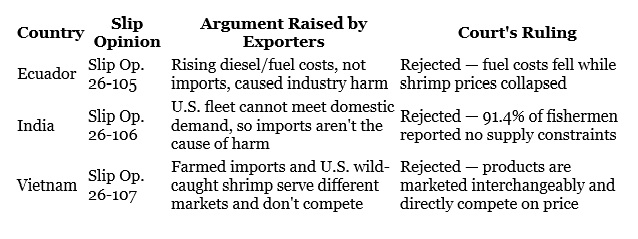
Court Finding (Slip Op. 26-105): Ecuadorian exporters argued diesel prices, not imports, caused the harm to the U.S. shrimp industry. The court disagreed, noting that fishermen’s fuel costs fell 21% from 2021-2023 even as their sale prices collapsed 42.6% – and that fishermen posted their worst losses in 2023, the year fuel costs were down. The court held, “the fishermen’s injury was not caused by their fuel and oil expenses, but rather by their falling prices as a result of subject imports.”
Today, fuel prices have increased sharply in a few months. However, shrimpers have consistently explained that they can absorb temporary fuel price increases if they receive a fair price for their shrimp that is not distorted by unfair trade.
Claim: U.S. shrimp can’t meet demand, so shrimp imports aren’t harmful
Court finding (Slip Op. 26-106): Indian exporters argued the U.S. fleet can’t meet U.S. demand, so imports cannot be blamed for harming the U.S. shrimp industry. The court found 91.4% of fishermen reported no supply constraints, and that reduced harvests were a response to falling prices, not scarcity. NOAA Fisheries repeatedly confirms that the shrimp growing off American coasts are thriving and sustainable. The court explained that the evidence before the ITC fully supported the conclusion that American shrimpers find it is “no longer viable for many of them to continue” to harvest shrimp at import-depressed prices. If U.S. shrimpers received a fair price, they can quickly increase production.
The Southern Shrimp Alliance has consistently argued that both domestic and foreign shrimp suppliers that produce to U.S. food safety, labor, and environmental standards and engage in competitive, fair trade benefit from actions that offset unfair trade practices. Because unfair trade practices include tolerating the abuse of veterinary drugs in foreign aquaculture, American consumers also benefit from the absence of contaminated shrimp from the market.
Claim: Imported shrimp play a complementary role to U.S. shrimp
Court finding (Slip Op. 26-107): Vietnamese exporters argued farm-raised imports and U.S. wild-caught shrimp do not really compete, instead filling different roles in the market. The court found shrimp is “frequently marketed and sold in ways that downplay the distinctions” between the two, that imports undersold domestic product in roughly two-thirds of tracked sales, and that half of surveyed buyers switched to imports because of lower prices.
This is consistent with recent DNA testing of shrimp dishes at restaurants that finds imported shrimp are typically actively marketed or mislabeled as U.S. wild-caught shrimp.
Next Steps
The exporters have 60 days to appeal the court’s decisions to the U.S. Court of Appeals for the Federal Circuit. The countervailing duty orders remain in effect and the U.S. Department of Commerce is currently conducting the first administrative review of this trade relief.
U.S. Shrimp Industry Response
Addressing one of the arguments from the Indian exporters, the Court of International Trade described it as “pettifoggery” that was “less than helpful to the court” – a characterization the Southern Shrimp Alliance says applies equally to the public repetition of court-rejected, unsupported, false arguments regarding the impact of unfairly traded farmed shrimp imports in the U.S. market. Over the course of twenty-three years, the U.S. shrimp industry has been required to demonstrate, through the presentation of objective evidence, that cheap, unfairly traded foreign shrimp significantly harm American shrimpers and shrimp processors. Rather than address the damage caused by the perpetual race to the bottom, U.S. seafood importers have welcomed any practices, no matter how unethical, that increase their profits, such as forced labor, banned antibiotics, and mangrove deforestation.
“Over and over again, foreign exporters and U.S. importers repeat the same falsehoods hoping that they will find someone, anyone, who will buy what they are selling,” said Blake Price, Executive Director of the Southern Shrimp Alliance. “But whenever they are asked to prove their claims, they fall short. The Court of International Trade’s decisions Friday once again spotlight the truth: subsidized foreign farmed shrimp is harming American shrimpers, their families, and their communities.”
Case Reference Table
- Slip Op. 26-105 (Ecuador): https://shrimpalliance.com/wp-content/uploads/2026/09/26-105.pdf
- Slip Op. 26-106 (India): https://shrimpalliance.com/wp-content/uploads/2026/09/26-106.pdf
- Slip Op. 26-107 (Vietnam): https://shrimpalliance.com/wp-content/uploads/2026/09/26-107.pdf